
Common Symptoms
- Localized tooth pain when biting or releasing pressure
- Deep isolated periodontal pocket next to one root
- Suspected vertical fracture after root canal, post, crown, or trauma
- Narrow vertical bone defect or unexplained root-adjacent bone loss
Root Fracture Signs on Dental CBCT
Understand possible root fracture signs on dental CBCT, including fracture lines, vertical bone defects, periapical changes, root separation, and metal artifact limitations.
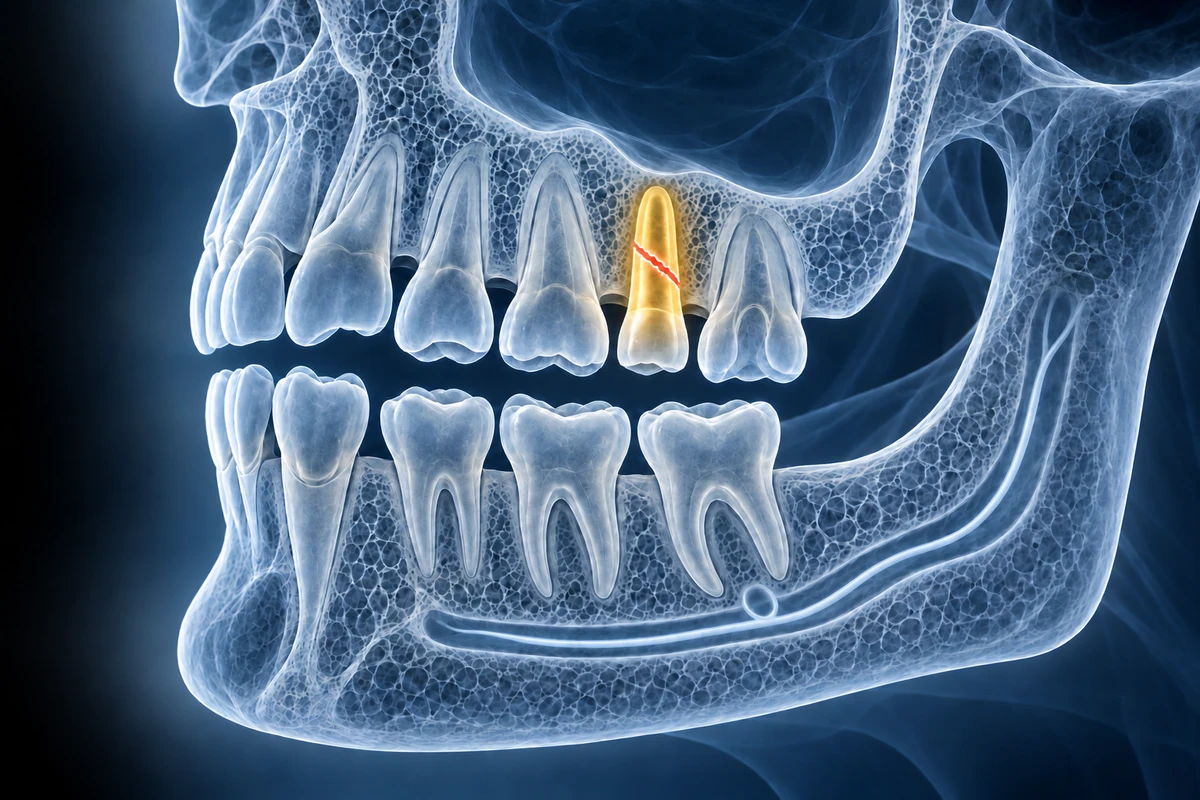
Root fractures can be difficult to see because dental roots overlap with bone, crowns, posts, and fillings. CBCT may help by separating structures into thin slices, but metal artifact and very fine fracture lines can still limit visibility.
A suspected root fracture should always be interpreted with symptoms, probing depths, percussion testing, restorability, and dental history. Imaging is one part of the decision.
Root fracture questions often overlap with periapical lesions because both can create root-adjacent bone changes. Review the root fracture CBCT signs guide and the periapical lesion CBCT explainer before asking your dentist which finding best matches the full clinical picture.
CBCT Findings Dentists May Evaluate
- Possible fracture line through the root or root filling material
- Narrow vertical bone defect tracking along one side of a root
- Root segment separation, displacement, or unusual root shape
- Metal artifact from posts, crowns, implants, or dense fillings
Inspect the Root in Multiple Planes
Use the free CBCT viewer to compare axial, sagittal, and coronal slices around the suspected root before discussing the scan with your dentist.
View Root CBCTFrequently Asked Questions
Can CBCT always prove a root fracture?
No. CBCT can help, but small fractures and metal artifact can still be hard to interpret. A dentist or endodontist must correlate imaging with symptoms and clinical tests.
Why does metal artifact matter?
Posts, crowns, and dense fillings can create streaks or dark bands that mimic or hide fracture lines. Your clinician weighs image quality before relying on a CBCT finding.
What should I ask after a suspected root fracture?
Ask which root is involved, whether the tooth is restorable, what clinical tests support the imaging finding, and whether extraction, monitoring, or endodontic care is being considered.
Related Articles
📖
How to Read a Dental CBCT Scan: A Patient Guide
📖Learn how to understand dental CBCT views, slices, MPR planes, tooth roots, jawbone, sinuses, mandibular canal, and common report terms.
Root Fracture CBCT Signs: What Dental CT Can and Cannot Show
Understand possible root fracture signs on CBCT, metal artifact limits, vertical bone defects, fracture lines, and why clinical testing still matters.
Upload your imaging to check for Root Fracture
Upload your MRI or X-ray DICOM files for private, AI-powered analysis. 4 models analyze independently — raw scan files stay in your browser.
Upload & AnalyzeMedical Disclaimer: This page is for informational and educational purposes only. It does not constitute medical advice, diagnosis, or treatment. AI-generated analysis may contain errors. Always consult a qualified healthcare professional for medical decisions. Full Disclaimer