
Common Symptoms
- Rounded or cyst-like area reported in the jawbone
- Finding associated with an impacted tooth, tooth root, or extraction site
- Jaw swelling, pressure, or incidental radiographic finding
- Concern about nearby teeth, sinus, cortical bone, or mandibular canal
Jaw Cyst on Dental CBCT
Use CBCT to understand a jaw cyst or cyst-like lesion, including size, borders, tooth relationship, cortical expansion, sinus proximity, and mandibular canal proximity.
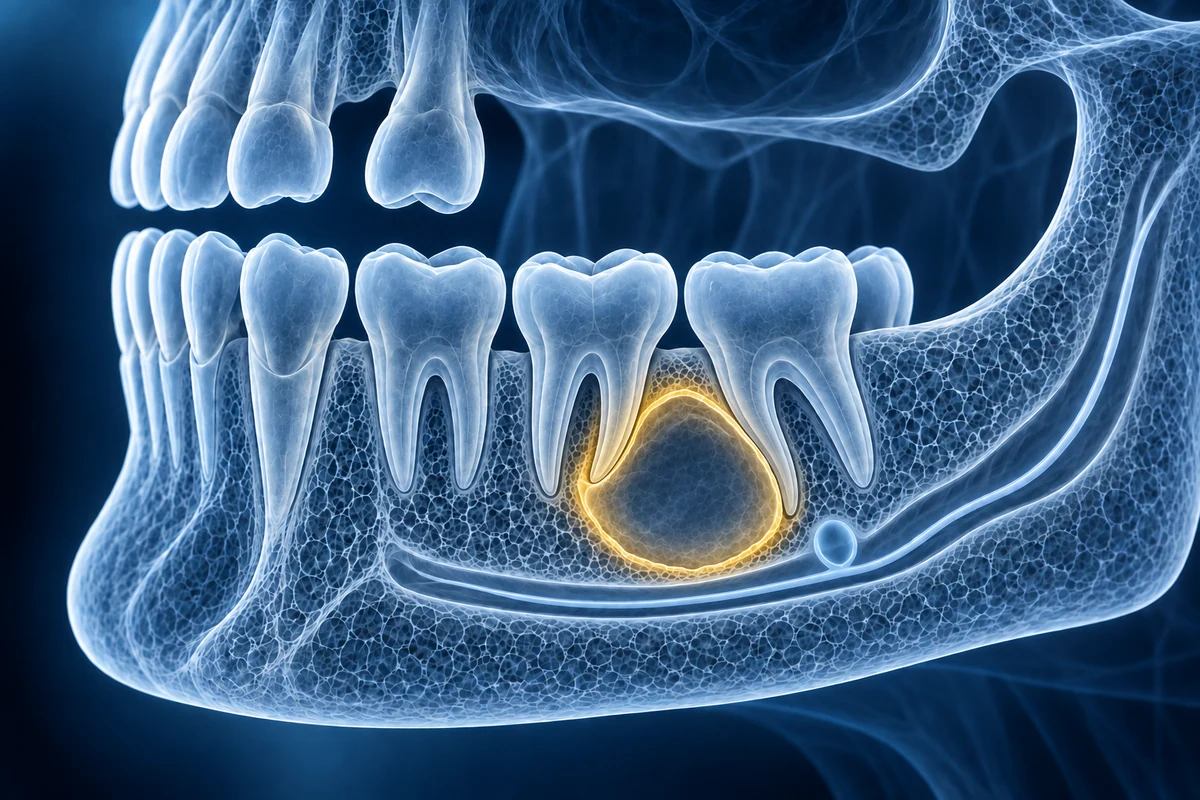
Jaw cysts and cyst-like lesions are often evaluated with CBCT because size, borders, tooth relationship, sinus proximity, and nerve proximity are easier to understand in three dimensions.
Imaging can describe what a lesion looks like, but the final cause may require dental examination, follow-up imaging, biopsy, or pathology depending on the case.
Jaw Lesion Details to Review
- Size, shape, and whether the borders look corticated or irregular
- Relationship to tooth roots, an impacted tooth crown, or prior extraction
- Cortical expansion, thinning, or interruption in the jawbone
- Distance to the mandibular canal, maxillary sinus, or nasal floor
Open the CBCT and Prepare Better Questions
Inspect the finding privately, then ask your dentist or oral surgeon what diagnosis, follow-up, or treatment path is being considered.
View Jaw CBCTFrequently Asked Questions
Can CBCT tell what type of jaw cyst it is?
CBCT can narrow possibilities by showing location, borders, and anatomic relationships, but it usually cannot provide a final diagnosis. Some lesions require clinical follow-up, biopsy, or pathology.
Should I worry if a jaw cyst was found incidentally?
Many findings are discovered incidentally, but they still need professional review. Your clinician will consider symptoms, growth, appearance, and proximity to teeth, nerves, or sinuses.
What should I ask my oral surgeon?
Ask which diagnosis is most likely, whether biopsy is needed, whether nearby teeth are affected, how close the lesion is to the nerve or sinus, and what follow-up interval is appropriate.
Related Articles
📖
Do You Need a 3T MRI for Dental or Jaw Imaging?
📖Learn when dental and jaw problems usually need CBCT, panoramic X-ray, or intraoral imaging instead of 3T MRI, and when TMJ or soft-tissue MRI may make sense.
CBCT vs Panoramic X-ray: When Dental 3D Imaging Helps
Compare dental CBCT and panoramic X-ray for wisdom teeth, implants, jaw cysts, root problems, orthodontics, radiation tradeoffs, and second opinions.
Upload your imaging to check for Jaw Cyst
Upload your MRI or X-ray DICOM files for private, AI-powered analysis. 4 models analyze independently — raw scan files stay in your browser.
Upload & AnalyzeMedical Disclaimer: This page is for informational and educational purposes only. It does not constitute medical advice, diagnosis, or treatment. AI-generated analysis may contain errors. Always consult a qualified healthcare professional for medical decisions. Full Disclaimer