
Common Symptoms
- Missing tooth area being evaluated for implant placement
- Concern about bone height, ridge width, or bone grafting
- Upper jaw implant site close to the maxillary sinus floor
- Lower jaw implant site close to the mandibular canal or mental foramen
- Planning questions before a surgical guide or second opinion
Dental Implant CBCT Planning: Bone Width, Sinus, and Nerve Distance
Review dental implant CBCT planning signs, bone height and ridge width, sinus floor position, mandibular canal distance, mental foramen proximity, and grafting questions.
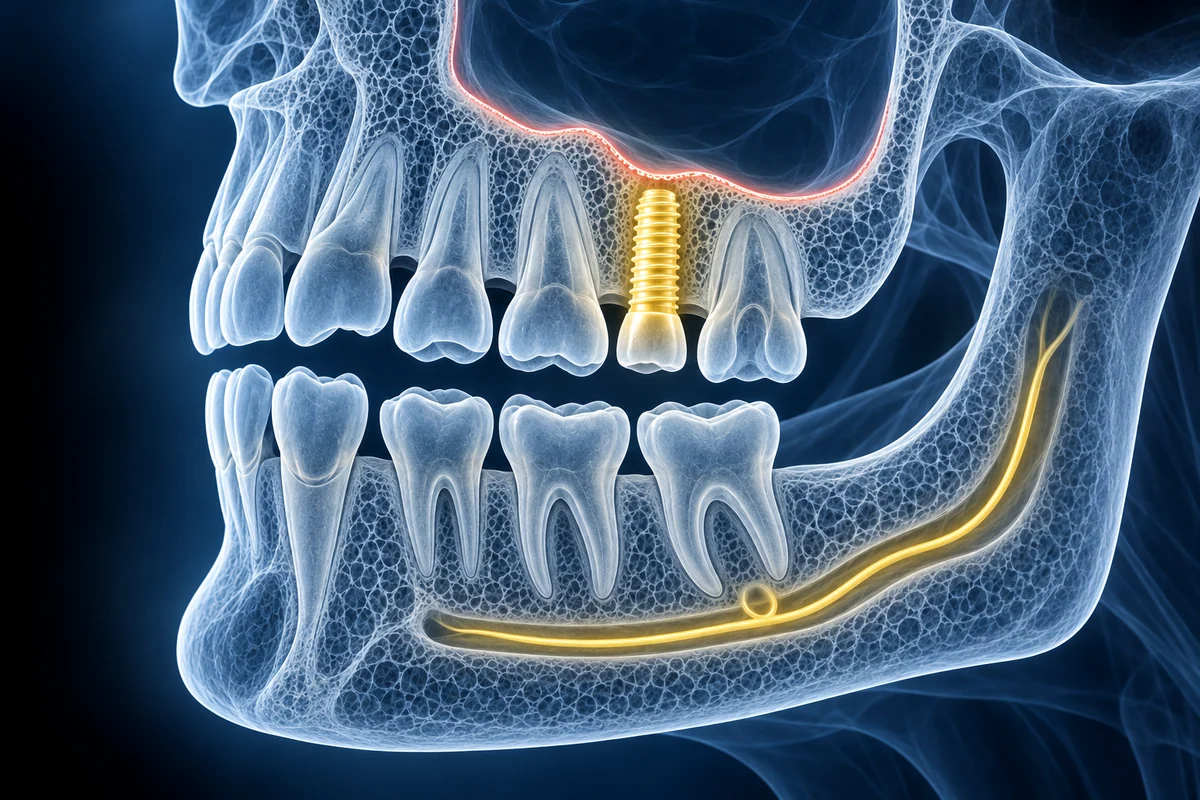
Dental implant planning uses CBCT to measure the three-dimensional bone envelope around a future implant. The scan helps clinicians evaluate ridge width, vertical bone height, sinus floor position, mandibular canal distance, and whether grafting may be needed.
Patients can use Analyze My Teeth to preview the CBCT and understand the anatomy being discussed. The viewer does not place implants or replace a clinician, but it can make second-opinion conversations clearer.
Implant CBCT review should stay dental-specific: measure the ridge in cross-section, identify the mandibular canal and mental foramen, inspect the sinus floor, and note extraction socket or grafting limitations. For deeper context, read the implant CBCT planning guide and the dental CBCT reading guide.
When the same scan also mentions root-tip changes or a possible crack, review those as separate dental findings: periapical lesion on CBCT and root fracture CBCT signs explain different questions than implant position.
Implant Planning Details to Review
- Available bone height and width at the planned implant site
- Distance to the mandibular canal, incisive canal, or mental foramen
- Maxillary sinus floor position and possible sinus lift planning
- Bone defects, extraction socket shape, and grafting discussion points
Open Your Implant CBCT Privately
Use the free CBCT viewer to inspect slices before deciding what to ask your implant dentist, periodontist, or oral surgeon.
View Dental CBCTFrequently Asked Questions
Can I plan an implant myself from CBCT?
No. CBCT can help you understand anatomy, but implant planning requires a licensed clinician who evaluates bite, restorations, surgical access, medical risk, and the prosthetic plan.
What measurements matter most for implants?
Bone width, vertical height, distance to nerves, sinus position, and restorative space are key. Your clinician also considers tissue thickness, bite forces, adjacent teeth, and whether a surgical guide is needed.
Does CBCT show whether I need bone grafting?
CBCT can show bone defects and ridge dimensions that influence grafting decisions. The final plan depends on clinical examination, implant position, restoration goals, and the surgeon's technique.
Related Articles
📖
How to Read a Dental CBCT Scan: A Patient Guide
📖Learn how to understand dental CBCT views, slices, MPR planes, tooth roots, jawbone, sinuses, mandibular canal, and common report terms.
Do You Need a 3T MRI for Dental or Jaw Imaging?
📖Learn when dental and jaw problems usually need CBCT, panoramic X-ray, or intraoral imaging instead of 3T MRI, and when TMJ or soft-tissue MRI may make sense.
Dental Implant CBCT Planning: What Patients Should Notice
Learn what implant clinicians evaluate on CBCT, including bone height, ridge width, sinus floor, mandibular canal, mental foramen, and surgical guides.
Upload your imaging to check for Dental Implant Planning
Upload your MRI or X-ray DICOM files for private, AI-powered analysis. 4 models analyze independently — raw scan files stay in your browser.
Upload & AnalyzeMedical Disclaimer: This page is for informational and educational purposes only. It does not constitute medical advice, diagnosis, or treatment. AI-generated analysis may contain errors. Always consult a qualified healthcare professional for medical decisions. Full Disclaimer