
Your Child's Panoramic X-ray (OPG) Explained: Developing Teeth, Crowding, and Crossbite
A parent's guide to reading a child's panoramic dental X-ray: what the rows of unerupted teeth mean, how to tell normal development from crowding, what it can and cannot say about jaw expansion, and how to get a structured second opinion.
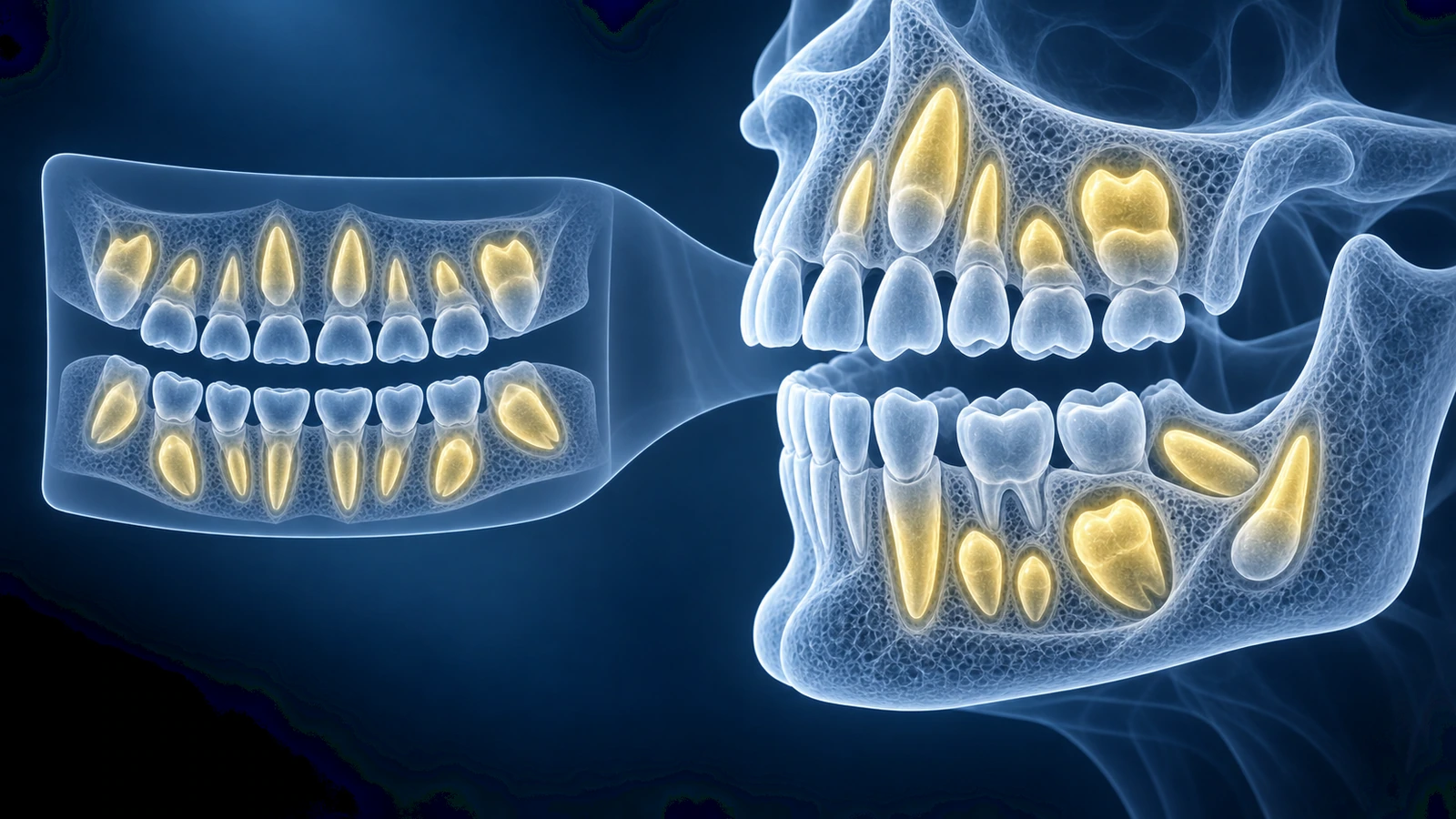
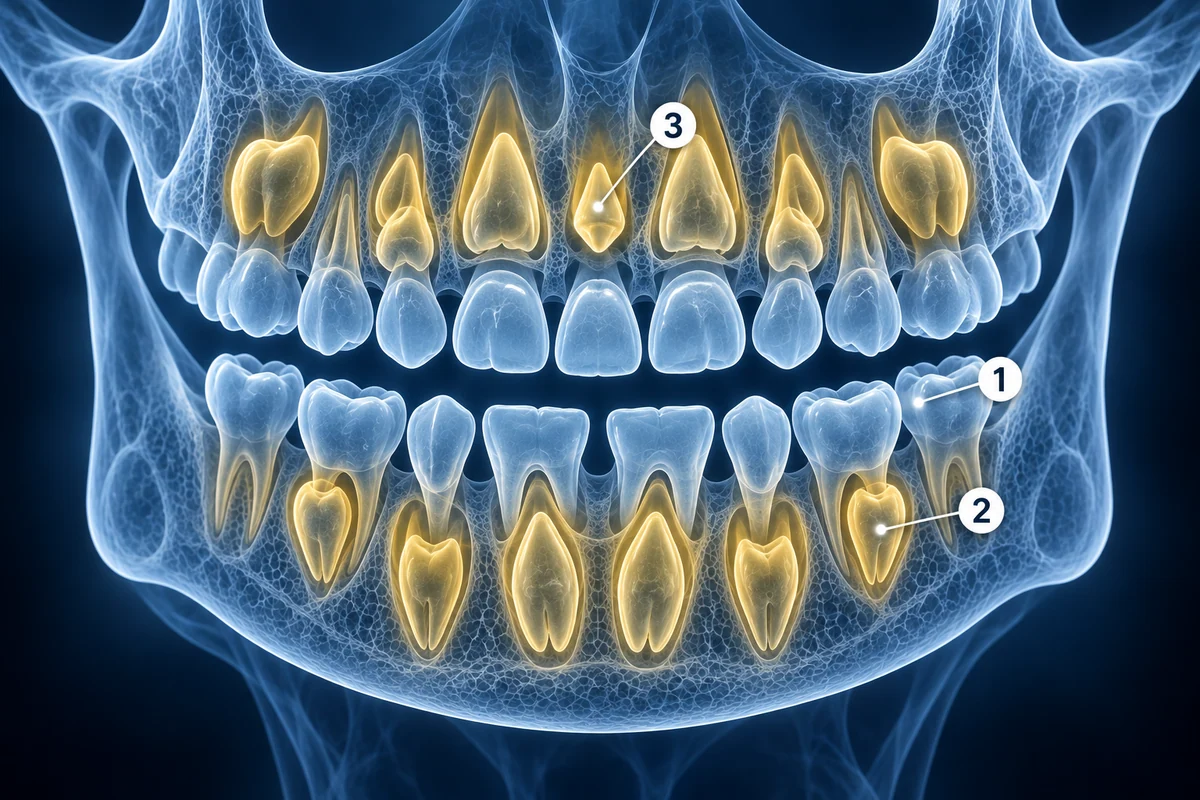
A panoramic X-ray (also called an OPG or orthopantomogram) is a single wide image that unrolls both jaws onto one picture. For a child it can be alarming at first glance — there appear to be far too many teeth. That is normal: you are seeing the baby teeth that have erupted plus the permanent teeth still developing in the bone, stacked above and below them.
The panoramic is the record that complements a 3D surface scan: the scan shows the bite and spacing of the teeth you can see, while the panoramic shows the teeth you cannot — the ones still forming. Together they answer far more than either alone.
What a child’s panoramic can show
- Which permanent teeth are present and developing, and which are missing
- Extra (supernumerary) teeth and the eruption sequence, left versus right
- A gross impression of whether developing teeth look crowded or have room
- Over-retained baby teeth, large cavities, and obvious jaw lesions
What it cannot decide — including jaw expansion
A panoramic is a 2D image with uneven magnification, so it cannot give exact measurements and cannot establish a narrow jaw or a true crossbite — those are transverse (side-to- side) findings it physically cannot show. So a panoramic helps confirm the teeth are developing and gives a crowding impression, but it cannot prove an expander is needed. That decision combines a clinical exam, a surface scan or models, and sometimes a CBCT. The early-orthodontics parent guide covers how to weigh a proposed plan.
Get a second opinion on the panoramic
Upload the panoramic image and get a structured, multi-model read of development, eruption, and crowding — with questions to ask your dentist. Not a diagnosis.
Analyze a Panoramic X-rayKey Takeaways
- The extra rows of teeth in a child’s panoramic are normal developing teeth
- It shows which permanent teeth exist and a gross crowding impression
- It cannot measure jaw width or prove a crossbite or the need for expansion
- Pair it with a 3D surface scan for the bite, and ask what problem is treated
Frequently Asked Questions
Why does my child’s X-ray look so crowded with teeth?
Because you are seeing two dentitions at once — the baby teeth in the mouth and the permanent teeth still forming in the jaw. This double row is the expected appearance in a school-aged child and is not itself a sign of a problem.
Can the panoramic tell me if my child needs an expander?
Not on its own. It cannot measure jaw width or confirm a crossbite, which are the usual reasons for expansion. It confirms which teeth are developing and gives a crowding impression; the expansion decision needs a clinical exam and a surface scan or models.
Is a panoramic X-ray safe for children?
A panoramic uses a low radiation dose and is commonly used in children when there is a clinical reason. Whether one is needed is a decision for your dentist; this tool only helps you understand a film that has already been taken.
Ready to analyze your imaging? Upload your MRI or X-ray for AI-powered analysis
Upload your MRI or X-ray DICOM files for private, AI-powered analysis. 4 models analyze independently — raw scan files stay in your browser.
Start AnalysisMedical Disclaimer: This page is for informational and educational purposes only. It does not constitute medical advice, diagnosis, or treatment. AI-generated analysis may contain errors. Always consult a qualified healthcare professional for medical decisions. Full Disclaimer